The Hidden Weakness Behind Record Stock Market Highs Could Soon Become Impossible to Ignore

Past the Point of No Return? Why the Economy May Be Entering a More Dangerous Phase
At first glance, the financial markets appear stronger than ever. Major stock indexes continue to flirt with record highs, investors remain enthusiastic about artificial intelligence, and official economic data has not yet confirmed the arrival of a recession. However, beneath the surface, a different picture is beginning to emerge—one marked by sector rotations, weakening corporate performance, rising layoffs, growing credit market stress, and increasing concerns over energy supplies.
Taken individually, none of these developments necessarily signals an imminent economic collapse. Taken together, however, they suggest that the foundations supporting the current economic expansion may be showing cracks.
A Strong Market Hiding Growing Weakness
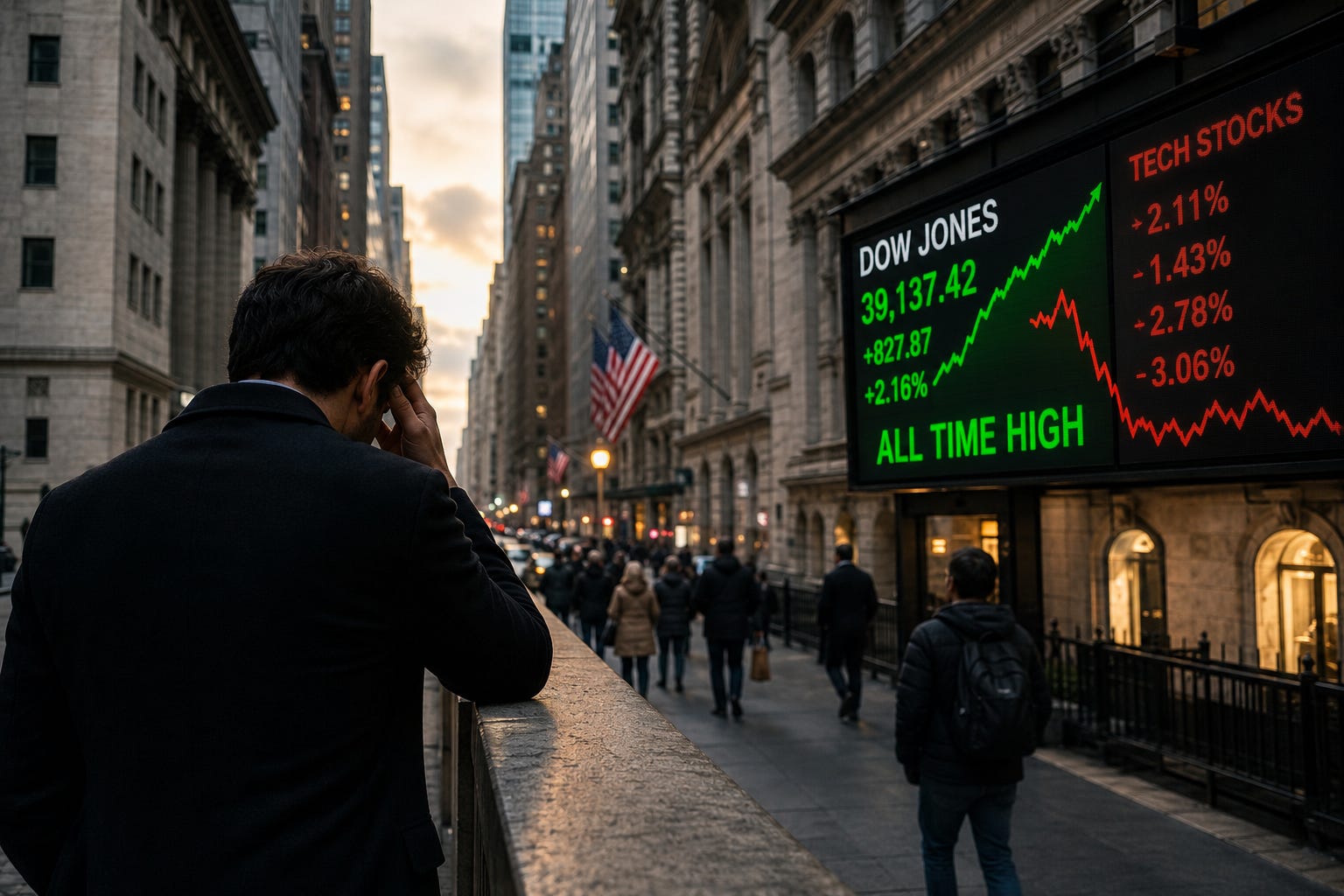
One of the most striking developments recently was the sharp divergence between the overall stock market and some of its most important leaders.
While the Dow Jones Industrial Average surged higher, many technology and semiconductor stocks experienced significant declines. Broadcom fell more than 12% after disappointing investors with its revenue outlook, while Micron Technology dropped more than 8%. Across the semiconductor sector, losses were widespread and severe.
What makes these moves noteworthy is not simply their size, but what they may represent. Investors appear to be rotating away from the companies that have led the market’s extraordinary rally over the past two years and into more defensive sectors such as banking, financial services, and other traditionally lower-growth industries.
Market rotations are not unusual. In many cases, they simply reflect investors taking profits and repositioning portfolios. However, history shows that major market downturns often begin with subtle shifts in leadership before broader weakness becomes visible.
The dot-com bubble provides an important example. Before the broader market collapse became obvious, investors first began abandoning weaker technology companies whose earnings failed to justify their valuations. Eventually, the selling spread throughout the sector, including companies that would later become dominant players in the digital economy.
Even many of the eventual winners suffered enormous losses and required years to recover.
Today’s AI boom is not identical to the dot-com era, but the similarities are difficult to ignore. Investors have rewarded AI-related companies with enormous valuations based largely on future expectations. As those expectations become increasingly difficult to exceed, even small disappointments can trigger substantial corrections.
The AI Boom Faces Practical Limits
Another emerging challenge involves the physical infrastructure required to support artificial intelligence.
Building and operating massive data centers requires enormous amounts of electricity, water, land, and capital investment. As projects expand, communities are increasingly raising concerns about environmental impact, resource consumption, and local infrastructure strain.
Reports that major AI-related infrastructure projects may be scaled back reflect a broader reality: technological revolutions are not driven solely by software innovation. They also depend on physical resources, political support, and economic sustainability.
The AI revolution remains very real, but the market may be beginning to recognize that growth cannot continue indefinitely at the same pace.
Geopolitical Risks Are Returning to the Forefront
At the same time, geopolitical tensions are once again becoming a significant concern for investors.
Military escalation involving Iran and the United States has raised fears about the stability of global energy markets. Whenever tensions increase in the Persian Gulf region, investors immediately begin assessing the potential impact on oil supplies, shipping routes, and inflation.
Energy markets are particularly sensitive because oil remains deeply embedded in nearly every aspect of modern economic activity. Transportation, manufacturing, agriculture, logistics, and consumer goods all depend on stable fuel supplies.
Even the possibility of supply disruptions can drive prices higher, creating inflationary pressures that ripple throughout the economy.
Labor Market Resilience May Be Fading
For much of the post-pandemic period, the labor market has remained surprisingly strong. Unemployment stayed relatively low despite aggressive interest-rate increases and slowing economic growth.
Recent data, however, suggest that conditions may be beginning to soften.
Jobless claims have risen, and technology companies continue announcing large workforce reductions. Particularly noteworthy is the growing role of artificial intelligence in corporate restructuring decisions.
Many firms are increasingly citing automation and AI adoption as reasons for reducing headcount. This represents more than a temporary economic adjustment. It reflects a structural transformation of the labor market itself.
While AI creates opportunities and new industries, it can also eliminate certain categories of jobs faster than new positions emerge. This transition may prove difficult for many workers, particularly those whose skills become less valuable in increasingly automated environments.
Another concerning trend is the rise in long-term unemployment. Historically, when unemployed workers remain out of the labor force for extended periods, it often signals deeper economic weaknesses that are not immediately visible in headline statistics.
Stress Is Emerging in Credit Markets
Perhaps one of the less discussed but potentially more important developments is the growing strain within private credit and private equity markets.
Several major investment firms have recently taken steps to limit investor withdrawals from certain funds. While these measures are designed to prevent disorderly exits and protect long-term investors, they can also indicate growing concerns about liquidity.
Credit markets often serve as the economy’s circulatory system. When investors become nervous about lending, refinancing, or asset values, financial stress can spread quickly.
History repeatedly shows that major financial crises rarely begin in the most visible areas of the market. Instead, they often start in corners of the financial system where leverage, illiquidity, and risk accumulation have gone largely unnoticed.
The question is not whether private credit will become the next crisis. The question is whether current stresses represent isolated incidents or the early stages of something larger.
The Energy Challenge Ahead
Among all current concerns, energy may ultimately prove to be the most significant.
Several industry executives have warned that oil inventories are approaching unusually low levels. According to these warnings, continued supply disruptions could lead to sharp price increases if inventories decline further.
Oil inventory dynamics are important because shortages cannot be solved instantly. Even if geopolitical tensions were resolved tomorrow, restoring normal supply chains would take time. Shipping schedules, transportation networks, refinery operations, and storage systems all operate on timelines measured in weeks or months rather than days.
As inventories fall, markets become increasingly sensitive to unexpected disruptions.
Should oil prices rise dramatically, the consequences would extend far beyond gasoline stations. Higher energy costs would feed directly into transportation expenses, manufacturing costs, food prices, and consumer inflation.
This would place central banks in a difficult position: either maintain higher interest rates to fight inflation or lower rates to support slowing economic growth.
Neither choice would be painless.
Are We Truly Past the Point of No Return?
Claims that economic collapse is inevitable are almost certainly overstated. Economies are complex, adaptive systems capable of surprising resilience. Predictions of imminent collapse have frequently proven wrong throughout history.
However, dismissing all warning signs would be equally dangerous.
What appears to be developing is not necessarily a sudden collapse, but rather a convergence of multiple vulnerabilities:
Elevated market valuations.
Dependence on AI-driven optimism.
Rising geopolitical tensions.
Weakening labor conditions.
Growing stress in private credit markets.
Potential energy supply constraints.
Persistent inflationary pressures.
Any one of these challenges might be manageable on its own. Together, they create an environment where shocks can spread more easily and where investor confidence becomes increasingly fragile.
The months ahead may reveal whether these developments represent temporary turbulence or the beginning of a more significant economic adjustment. Either way, the evidence suggests that the global economy is entering a period where risks deserve far more attention than recent market highs might imply.